
Blog 125 The Great Fires of 1916

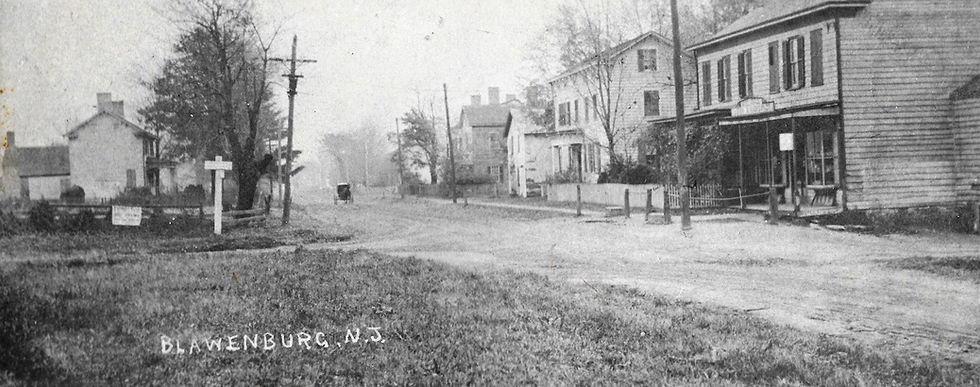
On Wednesday afternoon, December 6, 1916, residents saw large plumes of smoke rising north of Blawenburg near the State Village for Epileptics. In this blog, we explore this fire and how fires were fought over a century ago. While it was thought to be one fire, it turned out to be three.
December is not a prime season for forest fires; however, this December must have been dry with no snow on the ground. According to the Paterson Morning Call newspaper, there was a northeast gale blowing that fanned the flames and caused the fire to spread rapidly.
Reporting the Fires
It was important to let people know that a fire was underway. This was not an easy task in 1916, since the primary means of communication were the telephone and word of mouth. There were no fire sirens to alert the public or notify potential firefighters. Residents used the telephone to recruit help. However, this only worked if the recruitees had a phone. Not everyone did in those days.
Neither Belle Mead nor Blawenburg had a fire company. While Rocky Hill had a fire company that officially originated in 1902, its equipment was meager by today’s standards. It had a hand-drawn pumper filled with water that had to be pulled to the fire scene by firefighters. They had to manipulate levers on the pumper to put water on the fire. This apparatus had to be moved to the fire scenes by horses. Eventually, hand pumpers were replaced by steam pumpers, which could hold much more water than hand pumpers.

A steam pumper is pulled by horses.
Today we have fire departments with volunteer firefighters who can be notified about a fire in a matter of minutes. They have equipment worth millions of dollars to use, and if more help is needed, they can draw in additional equipment from neighboring towns. In 1916, it sometimes took hours to get sufficient help to the scene of a fire. Today, a 911 cell phone call can recruit help quickly.
The Fires
The Paterson Morning Call reported in its December 8 edition, “A smoke-blackened and weary line of 200 men extending across a three-mile line this morning gained mastery over the first forest fires which have visited this section of Somerset County (Skillman). They were not victorious, however, until there was a charred and blackened belt covering hundreds of acres… its burned sticks and ruins representing a property valued at more than $100,000.”
The location of the fires was on farms and woodlands north and west of the State Village for Epileptics. The fires were swept westward and northward toward Sourland Mountain. It was initially reported as a single blaze, but the State Fire Warden’s investigation found that it was three intense fires that charred 1,000, 640, and 60 acres. While it wasn’t stated, it is presumed that embers from one fire ignited another.
There was a loss of many acres of farmland, timber, houses, and barns. Newspaper accounts of the fire varied greatly on its length and width, giving totals that far exceeded the acreage claimed by the state report. For example, the Cranberry Press, in its Friday, December 8 edition, put the area of the fires at six miles long by three miles wide. They reported that by late Thursday night the fires were still burning.
The firefighters were especially concerned with the buildings and patients at the New Jersey State Village for Epileptics at Skillman. As the fires grew, one of them directly affected the State Village, which was established in 1898. Its buildings were spread over a large tract of land, and the fire threat was real. Its newest building, Smalley Hall, which was built to be a combination gym and auditorium, had just completed construction that year. Fortunately, there was a shift in the wind, and the fire was swept westward, away from the State Village. There were no reports of injuries or building damage.

How the Fires Started
It’s anyone’s guess how the fires started. In checking several references, each suggested a different cause.
The Paterson Morning Call said it was believed that careless hunters accidentally started the fire, but it isn’t clear how.
Firefightersnation.com said munitions explosions caused the fires.
Other alleged causes included:
an accidental ignition by a worker taking inventory of flammable materials,
an overheated stove,
a barn fire that burned out of control.
In other words, the news media didn’t know how it started or why there were three fires. Arson was not mentioned in any report. The best we can say is that three fires started and spread because of dry, windy weather conditions. The wind helped the fire leap from one location to another.

A bucket brigade from an earlier era takes water from a well.
Fighting the Fire
Firefighting is difficult under any circumstances, but these fires engulfed such a large area that it was a challenge to control. Many farmers and other citizens came to fight the fires, but there was no organized fire department or fire trucks. They used whatever equipment they could find to put out the fire.
A common firefighting technique was the bucket brigade. Firefighters would line up from the nearest water source (stream, pond, well, hand pump, cistern, etc.) to the fire. They would fill the buckets with water and pass them along the line to put out the fire. Once emptied, they would pass them back and refill them. This was a slow process.
Another technique that was often used for field fires was the backfire. Firefighters would deliberately set a controlled fire ahead of where the fire was moving. By burning a section of the fire path, the fire would not have fuel when it reached the location and would burn out. This didn’t work all the time. The fire warden said that if this technique had been used more in these fires, they might have saved some buildings. Besides dousing the fire with water, firefighters also used hand tools like shovels and axes to extinguish the blaze.
Conclusion
The state investigation concluded that the 1916 Skillman fires covered more territory and caused more damage than any fires in that area in recent times. There have been other large fires in the Blawenburg area, such as the Wood Acres barn fire; but the 1916 fires may rank as one of the largest in terms of ground coverage in Montgomery Township. It took several days to extinguish the blazes.
Fires of all types still happen regularly today, but we can be grateful that we have equipment such as home fire alarms and fire extinguishers, well-equipped fire departments, and excellent communication systems to minimize the damage compared with earlier times.
__________
Also of Interest
1. The Paterson newspaper put the value of the property and forest loss at $100,000. According to the Inflation Calculator, that would be about $3,000,000 today. However, the state report and other sources assessed the cost of the fire at much less.
2. Farm fires often started in the barn. If a barn were fully engulfed, firefighters would focus on saving other buildings such as houses and let the barn burn itself out. This would often take days, especially if the barn was filled with tightly packed hay.
3. Two references to patients at the State Village in the Paterson Morning Call stood out as negative characterizations of people we would not use today. They referred to the residents as “inmates” when they were not criminals. In a second reference, they were called “feeble-minded”. Today, we realize epileptics are not feeble-minded. They have a condition that can be controlled by medication, so they can be fully functional.
4. The Blawenburg Fire Department was established in 1946 and was in the same building where the Blawenburg Post Office is today. You can read more about the history of the Blawenburg Fire Department in Blog 29, A Tale of Three Firehouses. Its first fire engine, a 1920 Child’s pumper, was donated from the Belle Mead Fire Company in 1946.
5. Rocky Hill Fire Department got its first motorized fire truck, a chemical truck mounted on a Model T Ford Chassis in 1922, too late to help in these fires.
Sources
Information
Paterson Morning Call, December 8, 1916
Firefighters Association—https://www.ffam.org/the-era-of-the-fire-horse/
Rocky Hill Fire Department—https://rhfd53.com/history
Google, ChatGPT, and Yahoo searches
Pictures
Smalley Hall—postcard
Bucket Brigade—FASNY Museum of Firefighting
Firefighters Association—steam pumper, https://www.ffam.org/the-era-of-the-fire-horse/
Writer—David Cochran
Editor—Barb Reid
Researcher—Ken Chrusz
Email: blawenburgtales@gmail.com
Blog website: http://www.blawenburgtales.com
Author site: http://www.dcochran.net
Copyright © 2026 by David Cochran. All rights reserved.

Comments